


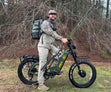


The Access Problem Every Public Land Hunter Knows
The walk-in rule is the ultimate equalizer on public land. Every hunter knows the math: if a road is gated shut to trucks and ATVs, the crowd drops by ninety percent. If you’re willing to lace up your boots, shoulder a heavy pack, and hike four miles into a ridge before the sun breaks, you earn the right to hunt undisturbed animals.
But anyone who has done that hike knows the other side of the math. Four miles in means four miles out. If you drop a mature elk or a heavy whitetail at the bottom of a draw, that four-mile hike transforms into a brutal, two-day, knee-destroying pack out. By the third trip hauling wet meat bags, you aren't thinking about the romance of the hunt anymore. You're just wondering if your spine is going to hold up.

For a long time, the only alternative was a gas-powered quad or a side-by-side. But the moment you crank an internal combustion engine, you destroy the very thing that makes public land great. You blow out the canyon with acoustic noise, leave a heavy trail of exhaust scent, and honestly, you’re legally restricted to the main motorized corridors anyway.
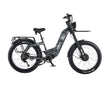
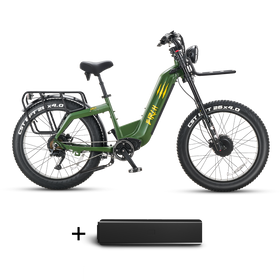
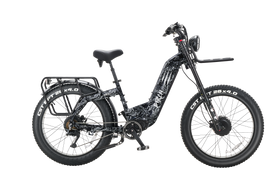
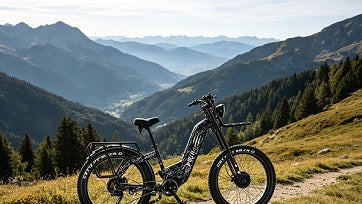
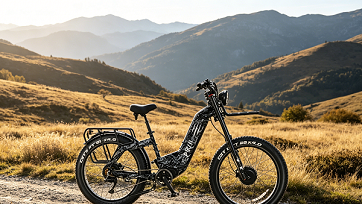
That is the exact access problem we all live with. And it’s exactly why I finally loaded a Birch Grolar AWD into the back of my truck this season. I wanted to see if an electric platform could bridge the gap between the speed of a motorized vehicle and the absolute stealth of a foot hunter.
After a few hundred miles on public ridges and gated forest roads, here is what I learned about how a hunting eBike changes the access game—and the stark realities nobody tells you before you buy one.
The Reality of the "Locked Gate"
Let’s clear up the biggest misconception about public land hunting with an eBike right now: It is not a blank check to ride anywhere you want. Federal agencies like the U.S. Forest Service (USFS) and the Bureau of Land Management (BLM) are paying attention. In most ranger districts, if a trail is strictly designated as "non-motorized," an eBike is viewed as a motor vehicle under their Travel Management Rules. If you get caught hammering a 1000W throttle up a hiking-only trail, you're going to get a heavy ticket from a game warden who has zero interest in your excuses.
But here is where things get interesting: The Motor Vehicle Use Map (MVUM). Every national forest has roads that are permanently closed to full-sized trucks and ATVs to prevent erosion or protect habitats, but are legally open to non-motorized bicycles. Depending on the local district, Class 1 eBikes (pedal-assist only, capped at 20 mph) are frequently permitted on these exact corridors.

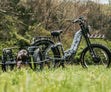
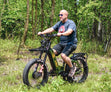
The first time I pointed the Birch at a gated, old logging road that cut through a chunk of public timber, it felt like cheating. On foot, navigating that gravel road to reach the back ridge takes an hour and a half of steady, sweat-inducing hiking. On the bike, with the dual motors quietly humming in Eco mode, I covered those three miles in twelve minutes.
I arrived at my glassing point before daylight, completely dry, with my heart rate sitting at a resting pace. I had the exact same physical energy and element of surprise as a walk-in hunter, but I had completely shrunk the distance.
Traction Physics: Why RWD Fails Where AWD Thrives
Before I rode the Birch Grolar, I spent some time on a buddy’s rear-wheel-drive hunting bike. On flat, hard-packed dirt, it was great. But public land terrain is rarely flat or hard-packed.
We took his bike up a steep, washed-out mountain switchback covered in loose shale and wet pine needles. The moment the grade hit about 20%, the rear tire started digging a hole. Because all the weight of his gear was over the back wheel, the tire lost traction, spun out, and he had to awkwardly step off and push a 90-pound machine up the rest of the mountain.
When I took the Grolar into a similar scenario—a sloppy, clay-slick bottomland near a public river boundary—I engaged the All-Wheel Drive switch on the handlebars.
What surprised me was the mechanical pull. It doesn't just push you from behind; the front hub motor actively claws at the terrain, pulling the front tire up and over slick roots and loose rock. Instead of fishtailing or washing out, the bike tracks completely straight. If you have the leg power to keep the pedals turning, the dual motors will find the grip to pull you through.
The Honest Truth: It’s Not a Traditional Mountain Bike
I promised to include the imperfections, so here is the thing nobody tells you in the glossy digital brochures: These things are heavy.
With the dual-motor setup and the massive 25Ah battery casing, the Birch Grolar sits right around 109 pounds.
Loading it into a truck bed by yourself at the end of a fourteen-hour day isn’t fun. It requires actual muscle.
If you lay the bike down on a steep, greasy hillside, you aren't just casually picking up a bicycle—you are lifting a compact motorcycle platform.
You also have to be smart about your battery management. A fat-tire eBike hauling gear over rugged public land burns through watt-hours significantly faster than a commuter bike on asphalt. I learned the hard way that if you run the AWD mode at full throttle up every ridge climb, your range will tank. I now use a simple rule: run it in single-motor RWD on the flat trails, and save the AWD "nuclear option" strictly for the nastiest mud, sand, or vertical climbs.
The Ultimate Payoff: The Pack Out
The moment an eBike completely justifies its existence on public land isn't the ride in—it’s the haul out.
Last November, we dropped a deer at the bottom of a steep, roadless draw two miles from the main gate. In the past, that meant cutting the animal into quarters, loading up frame packs, and committing to a grueling, multiple-trip slog that would take the rest of the night.
Instead, we loaded the meat into a heavy-duty, single-wheel cargo trailer hooked directly to the Grolar's integrated rear rack.
Towing an extra 100+ pounds of meat uphill on a standard bike usually makes the front handle twitchy and light, because the weight shifts entirely to the rear. But because the Birch has that front hub motor, the front end stayed weighted and kept tracking straight. The bike didn't stutter, the chain didn't snap under the strain, and the motors just quietly ground their way up the ridge.
We made it back to the truck in twenty minutes. My back didn't hurt, my knees weren't throbbing, and the meat was cooling in the ice chest before midnight.
An electric hunting bike won't find the animals for you, and it won't make you a better shot. And if you aren't willing to study your local MVUM maps and respect the regional forestry laws, you shouldn't buy one.
But if you understand the access regulations of your local public land, an AWD rig like the Birch changes the entire geometry of the hunt. It removes the physical penalty of exploring the deep woods. It allows you to go further, stay longer, and pack out your harvest with the kind of efficiency that used to require a team of mules.
For the public land hunter who wants to leave the crowd behind without destroying their body in the process, the game has officially changed.



Leave a comment
All comments are moderated before being published.
This site is protected by hCaptcha and the hCaptcha Privacy Policy and Terms of Service apply.