



Why E-Bikes are the Future of Forest Law Enforcement
In the vast, rugged expanses of our national forests and state parks, the traditional tools of law enforcement are facing a quiet revolution. For decades, "patrol" meant either the slow pace of a foot beat or the loud, disruptive presence of a 4x4 truck or ATV.
The Unique Challenge of Backcountry Law Enforcement
Forest rangers and wildlife enforcement officers operate in a context that no urban patrol manual was written for. Their jurisdiction can span thousands of acres of wilderness. The people they're looking for — illegal hunters, poachers, illegal campers, resource thieves, or trespassers — actively listen for the approach of enforcement. The terrain they work in eats conventional vehicles. And the wildlife they're sworn to protect is spooked by exactly the kind of mechanical noise that a gas-powered ATV or patrol truck produces.

The patrol vehicle for backcountry law enforcement needs to satisfy several contradictory demands simultaneously: it must be powerful enough to handle rough terrain and carry equipment, but quiet enough to conduct covert observation. It must be fast enough to cover significant ground, but narrow enough to navigate trails that trucks and ATVs can't access. It must be operationally sustainable for long shifts, but simple enough to maintain in a remote deployment.
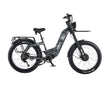
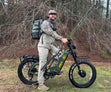
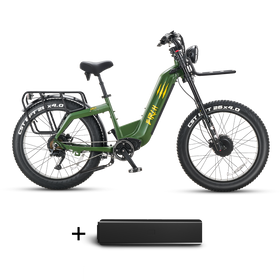
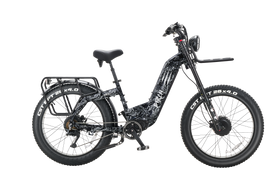
The utility patrol eBike — purpose-built, fat-tired, and electrically silent — meets every one of those requirements.
Silent Operation: The Tactical Advantage Nobody Talks About Enough
In law enforcement, the element of surprise is often the element of safety. An officer who can observe a situation before being observed has more information, more options, and more control over how an encounter unfolds. An officer whose arrival is announced a quarter mile in advance has none of those things.
Gas-powered vehicles — ATVs, dirt bikes, utility side-by-sides — broadcast their presence. The engine note of a four-stroke quad carries across open terrain and echoes through forest canopy. Anyone engaged in illegal activity has ample time to hear it coming, conceal evidence, relocate, or prepare a response. In backcountry enforcement, noise isn't just inconvenient — it's a genuine operational liability.
A quality patrol eBike produces a motor hum that dissipates within a hundred feet of the rider at low speeds. At walking pace on a dirt trail, it is functionally silent — no louder than a bicycle rolling over gravel. This gives the riding officer a capability that was previously unavailable: the ability to approach a location quickly and arrive unannounced.
For wildlife enforcement specifically, this matters even beyond the tactical dimension. Poachers who hear an approaching engine have time to stash evidence, disperse, or reposition. Illegal hunting activity that produces gunshots or camp noise gives rangers a directional signal to follow — and arriving on an eBike means following that signal without tipping off the suspect that law enforcement is closing in.
Access to Terrain That No Other Vehicle Reaches
Forest rangers and park law enforcement officers are responsible for patrolling some of the most challenging terrain in the country — national forests, wilderness areas, wildlife refuges, and protected backcountry that sees limited vehicle access by design. These are exactly the areas where illegal activity tends to concentrate, precisely because enforcement presence is hardest to maintain.
A patrol eBike changes the access equation. Where a truck stops at a locked gate, the eBike continues. Where an ATV tears up sensitive soil and spooks wildlife, the fat-tired eBike rolls quietly over the same ground with minimal surface impact. Where a foot patrol covers two miles in an hour, the eBike covers eight — with a rider who arrives at the destination with energy to spare, not a depleted officer who spent an hour of their shift just getting to the location.
The operational range of a quality patrol eBike — 60 to 85 miles on a single charge with a high-capacity 48V / 25Ah battery — allows a single officer to cover a patrol circuit that would previously have required either a vehicle (with its noise and access limitations) or significant physical exertion that compounds across a long shift. For agencies already stretched thin by staffing constraints, this is a force-multiplier with direct operational impact.

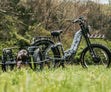
Fat tires (4 inches wide or greater) handle the terrain conditions that backcountry enforcement routinely encounters: muddy fire roads after rain, rocky singletrack, soft ground along creek corridors, and forest floor debris. The wide contact patch reduces ground disturbance compared to narrower tires, and low tire pressure allows the bike to conform to uneven surfaces — meaning the officer can focus on the patrol, not on managing the vehicle through technical terrain.
Carrying What the Job Actually Requires
A backcountry law enforcement officer doesn't ride out light. The operational kit for a field patrol in a remote wilderness area is substantial: radio equipment, first aid supplies, citation books and documentation tools, evidence collection materials, emergency signaling equipment, water, food for extended shifts, and often a long arm or sidearm and associated gear. Add personal protective equipment and the weight accumulates quickly.
A purpose-built patrol eBike handles this through a combination of payload capacity and purpose-designed mounting systems. Premium utility-class eBikes support combined rider-and-cargo loads of 400 lbs or more, providing genuine margin for a fully equipped officer. Front and rear rack systems offer organized mounting options for gear bags, equipment cases, and specialized holders.
For law enforcement applications, this extends to:
Radio and communications mounting. Handlebar-mounted or frame-mounted radio holders keep communications equipment accessible and protected from trail vibration.
Evidence and documentation kit. A secure rear pannier or hard-sided case protects paperwork, citation books, cameras, and sample containers from weather and impact.
Emergency medical supplies. Backcountry rangers are often first responders. A medical kit accessible from the rear rack means a ranger can initiate emergency care without dismounting and searching a bag.
Camera and observation equipment. Trail cameras, binoculars, and spotting scopes for wildlife monitoring and surveillance operations can be mounted or carried without compromising riding position.
Trailer capability. For operations requiring equipment transport — fence materials, removal of illegally placed equipment, or supply delivery to a fixed backcountry post — a rear hitch system extends hauling capacity dramatically.
What Agencies Are Using eBikes For
Poaching and Illegal Hunting Enforcement
Wildlife poaching is a nocturnal problem. Most illegal take happens in the hours before dawn and after dusk, in remote areas, by people who know what vehicle enforcement sounds like. The silent approach capability of a patrol eBike allows game wardens and wildlife officers to move through active poaching areas without announcing their presence — conducting surveillance, approaching suspects, and responding to gunshot reports without the advance warning that a gasoline engine provides.
Anti-Trespassing and Boundary Enforcement
Wilderness areas, wildlife refuges, and restricted forest zones regularly experience unauthorized access — off-road vehicles, illegal camping, and resource extraction. Patrolling these boundaries by eBike allows officers to cover perimeter trails quickly, respond to reported incursions, and conduct unannounced checks of known problem areas without the approach noise that prompts violators to relocate before enforcement arrives.
Trail and Recreation Area Compliance
High-use recreation areas present a different enforcement challenge: high visibility is often the goal, not stealth. Officers monitoring trail use regulations, campfire restrictions, permit compliance, and wildlife protection buffer zones benefit from the eBike's ability to cover miles of trail efficiently, interact with visitors from a non-intimidating platform, and respond rapidly to reported issues anywhere along an extended trail system.
Search and Rescue Response
Forest rangers and park law enforcement are frequently the first responders to search and rescue situations in backcountry terrain. Time to reach a distressed hiker or injured visitor is directly related to survival outcomes in serious emergencies. An eBike allows a ranger to cover ground to a last-known-location faster than foot patrol, carry first-response medical supplies in a way that's not possible while running, and navigate off-trail terrain that a vehicle can't access.
Wildfire Detection and Monitoring
During high-fire-risk periods, rangers conduct frequent patrols of fire-prone terrain to detect smoke, locate illegal campfires, and monitor known ignition risk areas. The eBike's silence is advantageous here too — approaching a suspected fire without the noise that would push people in the area away from where you need them to stay visible.
Operational Advantages Over Conventional Patrol Options
| Patrol eBike | ATV / Quad | Foot Patrol | Patrol Truck | |
|---|---|---|---|---|
| Noise level | Near-silent | 85–95 dB | Low | 70–85 dB |
| Trail access | Excellent | Good | Full | Road-only |
| Covert approach | Yes | No | Partial | No |
| Officer fatigue | Low | Low | High | Low |
| Fuel/operating cost | Minimal | Moderate-high | None | High |
| Environmental impact | Very low | Moderate | Minimal | Significant |
| Payload capacity | Up to 400 lbs | Up to 800+ lbs | 30–50 lbs | 1,000+ lbs |
| Speed on trail | 20–28 MPH | 25–45 MPH | 3–4 MPH | N/A off-road |
| Patrol range/shift | 60–85 miles | 60–100 miles | 8–15 miles | Unlimited |
The eBike occupies a capability niche that no other patrol vehicle fills: fast enough for meaningful terrain coverage, quiet enough for covert operations, light enough for trail access, and capable enough to carry full operational kit.
What to Look for in a Law Enforcement Patrol eBike
Not every eBike belongs in a law enforcement deployment. Agencies evaluating patrol eBikes for field operations should prioritize:
Motor power of 750W–1000W minimum. Patrol operations require consistent performance under load, in variable terrain, and across long shifts. Underpowered motors struggle under officer-plus-gear weight on inclines.
Mid-drive motor configuration. Mid-drive motors deliver torque through the bike's gearing system, providing superior climbing performance and a more consistent power curve than hub motors — critical for backcountry terrain where grades are unpredictable.
High-capacity battery (20Ah or greater). A full shift in the field can cover 40 to 60 miles. Battery capacity must provide genuine operational range, not just manufacturer-quoted range under ideal conditions.
Hydraulic disc brakes. Emergency stops on steep, loose, or wet terrain require brakes that perform reliably under thermal load. Hydraulic systems maintain consistent feel throughout the shift; mechanical systems degrade under heavy use.
Fat tires, 4" minimum. The terrain where this vehicle operates demands it. Narrower tires compromise stability and access in the conditions that make the eBike valuable in the first place.
Low-profile color options. Forest law enforcement operations benefit from a vehicle that doesn't announce itself visually any more than it does acoustically. Matte earth tones, camo finishes, or agency-specific color schemes support operational requirements.
Modular rack and mounting system. The gear loadout changes by mission. A robust, adaptable mounting system means the bike can be reconfigured for surveillance operations, trail patrol, first response, or heavy equipment transport without modification.
The Bigger Picture: Low-Impact, High-Presence Enforcement
There's a dimension to the patrol eBike that goes beyond tactical capability. Law enforcement in wild places carries a responsibility to the environment being protected. The agency whose officers patrol on electric bikes that leave no exhaust and minimal soil disturbance is practicing what it enforces. That consistency between stated mission and operational method matters — to the rangers who carry it out, to the communities who observe it, and to the ecosystems that have no voice in the matter.
The forest rangers, game wardens, and conservation officers who protect millions of acres of public land do it with limited resources, vast geography, and a mandate that doesn't shrink when the budget does. A vehicle that extends their effective patrol range, allows them to approach quietly, carry what they need, and go where trucks and ATVs can't — without burning fuel or disturbing the wildlife they're sworn to protect — isn't a compromise. It's an upgrade.
Silent. Capable. Low-impact. Built for the terrain that matters most.
That's what a purpose-built patrol eBike delivers to the officers who need it most.


Leave a comment
All comments are moderated before being published.
This site is protected by hCaptcha and the hCaptcha Privacy Policy and Terms of Service apply.