


Why E-Bikes are the Ultimate Tool for Photography Exploration
The alarm goes off at 4:15 AM. You pull on your layers in the dark, load the camera pack, and drive an hour to the trailhead — the one that puts you within range of the marsh where the great blue herons nest. By the time you hike in, it's already light. The best moment — that narrow window when the mist still hangs low and the first birds lift off against a pearl-gray sky — passed twenty minutes ago. You got close, but not close enough. Not in time.

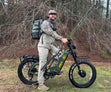
Now imagine you rode in instead. Quietly. Quickly. In the dark, without headlights spooking the birds, covering three miles of dirt trail in minutes rather than forty-five. You're set up, tripod planted, 500mm aimed at the rookery, while the sky is still doing exactly what you came for.
That's what a photography eBike actually changes — not just convenience, but the quality and character of the shots you come home with.
Why Noise Is the Enemy of Great Nature Photography
Every wildlife photographer knows the frustration. You spend weeks researching a location, studying migration patterns, planning around the golden hour. You drive hours, hike in, and then — a snapped twig, a diesel engine in the distance, the crunch of boots on frost — and the deer lifts its head, the heron takes flight, the fox slips back into the brush. The moment is gone.
Sound travels. In the pre-dawn stillness of a wetland or old-growth forest, even low-level noise carries hundreds of meters. Wildlife doesn't wait to see if the disturbance is a threat — their instinct is to move immediately, and once they've gone, most won't return to that spot for hours.
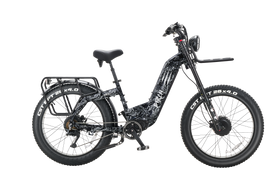
A quality fat tire hunting eBike produces almost no audible noise — a faint, low hum from the motor that dissipates within a few dozen feet. At slow approach speeds, many riders describe the experience as functionally silent — nothing like the mechanical clatter of a gas engine, and considerably quieter than the unavoidable sounds of hiking. You can roll to within striking distance of alert subjects in a way that simply isn't possible on foot or by any motorized alternative.
Reaching the Spots That Define the Shot
There's a reason so many iconic nature photographs are taken in the same handful of accessible locations — it's not that those are the best places. It's that they're the places people can actually reach.
The real photography is often happening miles further in — past the trailhead parking lot, past the managed viewpoint, beyond where most photographers are willing or able to walk with a 20-pound camera pack on their back. The remote alpine meadow that sees elk every morning before the herd drifts down to lower pasture. The river bend where the osprey fish because it's inaccessible enough that nobody disturbs them. The coastal bluff that requires a six-mile ride down an unmaintained fire road.
A photography eBike makes these locations accessible without the physical cost of hiking in and out with full gear — cost that matters enormously when you need to return to the same spot three mornings in a row to get the light you're after.
The numbers are concrete: a quality fat tire eBike with a 48V / 25Ah battery delivers pedal-assisted range of 60 to 85 miles per charge. That's enough to ride to remote locations, set up, wait through a shooting session, and ride back — day after day without range anxiety. For landscape photographers chasing dawn light across multiple locations in a single morning, the ability to cover ground quickly and arrive calm, not winded, is the difference between a good shoot and a great one.
The Silent Approach: Getting Closer Than You've Ever Been
Ask any experienced wildlife photographer what they'd trade for — and most will say proximity. The ability to get close enough that a 400mm lens feels like the right choice, not the desperate minimum. Close enough that you're photographing behavior, not a silhouette.
The near-silent operation of a modern eBike changes the math of wildlife approach in ways that are hard to overstate. Experienced nature photographers who've made the switch consistently report the same discovery: animals that would flush or retreat at the sound of footsteps or an ATV barely register an approaching eBike. Deer continue grazing. Herons hold their position. Shore birds that would scatter at a car door continue foraging.
This isn't just anecdote — it's biomechanics. Most prey animals have evolved to detect and respond to specific frequencies associated with predators: the snap of a twig underfoot, the low rumble of an internal combustion engine, the rhythmic crunch of a bipedal footfall. The smooth, continuous, low-frequency hum of an electric motor at low speed doesn't pattern-match to any of those threat signals. The result is an approach vector that was simply unavailable before the electric motor existed.
Hauling Real Camera Gear — Not Just a Smartphone
There's a version of "photography eBike" that means a rack for your mirrorless and a small lens. That's not what serious photographers need.
A full wildlife or landscape photography kit is heavy. A professional mirrorless body, a 500mm or 600mm telephoto, a spare body, battery packs, filters, a tripod or monopod, a head, a remote trigger, rain covers, a reflector — this isn't a light backpack. It's 25 to 40 pounds of glass and metal that needs to arrive at the location undamaged and accessible.

The best photography eBikes handle this in several ways:
Front and rear racks with high individual weight limits let you distribute the load across the bike rather than putting it all on your back. A rear pannier can carry the bulk of your kit while a front bag or handlebar mount keeps a second body or binoculars at arm's reach. Arriving at a location without the spinal compression of an hour-long carry means you can actually hold the camera still when you get there.
High total payload capacity (up to 400 lbs on premium utility-class eBikes) means you're never making compromises about what to leave behind. Bring the long lens and the backup body. Bring the heavy tripod head. Bring the extra battery packs for the camera, not just the bike.
Fat tires absorb trail vibration so the camera gear in your bags isn't subjected to constant shock. On a rigid frame or thin-tired bike, the hammering of a rocky trail can fatigue equipment mounts and connectors over time. Fat tires' inherent compliance smooths the ride even without suspension, protecting your investment.
Shooting Locations That Were Simply Off the Table Before
Here's a partial list of situations where a photography eBike opens doors that were previously closed:
Pre-dawn wildlife locations. Riding in before first light — quietly enough not to disturb roosting birds or sleeping predators, quickly enough to reach the spot before the window opens.
Restricted vehicle zones. Many national parks, wildlife refuges, and wilderness areas prohibit motorized vehicles but permit bicycles. An eBike, classified in most jurisdictions as a bicycle, gets you into areas where ATVs and off-road vehicles are banned — exactly the areas where wildlife is undisturbed and the photography is best.
Fire roads and logging tracks. Miles of unmaintained access roads exist across public land that are impassable by car but ride perfectly on a fat tire eBike. These corridors often lead to prime habitat that receives virtually no human pressure.
Wetlands and marsh edges. Soft ground that would bog down even a lightweight ATV is no obstacle for the fat tires and low weight of a photography eBike. Approach marsh edges, lake shores, and creek banks without the ground-disturbing ruts that announce your presence to every creature in the area.
Multi-location dawn shoots. Chase the light across multiple spots in a single morning — the overlook at sunrise, the valley meadow at golden hour, the river crossing when the mist lifts — covering distances that would require a vehicle but moving silently enough to work near wildlife at each stop.
Practical Tips for Photographers on an eBike
Use a handlebar bag for your second body. Keep it accessible and padded. The handlebar position is surprisingly stable and means you can grab the camera within seconds of stopping.
Carry a camera sling, not a backpack, for your primary body. When you're riding, a sling across the chest keeps the camera body secure and accessible without requiring you to dismount and unload a backpack each time you want to shoot.
Approach slowly on the lowest assist level. The quietest mode is the lowest power level. When you're within 200 meters of your subject, dial the assist down and let the fat tires roll quietly. This is the mode where the eBike's silence advantage is greatest.
Use a handlebar-mounted GPS. Remote locations without cellular coverage require offline maps. A dedicated GPS unit (or smartphone in a protective mount with pre-downloaded maps) is essential for navigating fire roads and unmaintained trails confidently.
Time your battery for the day's full route. Range is generous on quality eBikes, but factor in the full loop — ride in, wait time, ride out, plus any detours you make when the light is good and you chase it.
Bring a lightweight tripod clamp for the rear rack. A simple mount lets you attach a tripod horizontally across the rear rack, freeing your hands during the ride and making setup at the location faster.
Protect your gear from trail dust. Even moderate trails generate dust that will find its way into bags. Use weather-sealed camera bags or liner bags inside your panniers, especially on dry summer trails.
The Case for Going Further
The best nature photography has always required two things: skill and access. The skill part — understanding light, reading behavior, mastering composition — takes years of practice. But access? Access has always been limited by physical endurance, vehicle noise, and the practical boundaries of what you can carry on your back.
A silent, capable, long-range photography eBike collapses those limits. It extends your range beyond what your legs can carry. It approaches the subject without announcing itself. It hauls the full kit so you make no compromises on gear. And it gets you to locations that most photographers have simply given up on reaching.
The shots are out there — in the marsh before dawn, on the ridge above the tree line, at the far end of the fire road where nobody else goes. You just need a way to get there that doesn't chase them away.
That's what the photography eBike does. And once you've ridden one into the field, you'll never want to hike in without it again.


Leave a comment
All comments are moderated before being published.
This site is protected by hCaptcha and the hCaptcha Privacy Policy and Terms of Service apply.